Musings about willingness to wait (June 29, 2025)
Hey! Where's my "discount"? Psychologists and economists like to use interesting words to describe the phenomena that they observe. In this case, "discounting" refers to the tendency of humans to devalue goods that are received in the future. In fact, "devaluation" is probably a better word choice, but that is not my call!
Here are some unoriginal thoughts that I've taken from the book Misbehaving, by Richard Thaler. Lately, I've been reading a lot about how most people often make irrational decisions. The example below is intended to highlight one type of decision where this is the case.
Tickets to Wimbledon
Wimbledon is coming up, and after the marathon finish to the French Open, it's safe to say tennis fans are excited. If you are a tennis fan and you missed the French Open final, I encourage you to watch a re-run – It was quite the match (to say the least) between Carlos Alcaraz and Jannik Sinner.
Let's assume for the sake of this post that you're a tennis fan. Let's also assume that you won a lottery at work, and you get to choose between the following three ticket options (travel fully paid):
- Attend a first-round match at Wimbledon this year
- Attend a quarterfinal match next year
- Attend the championship match in two years
Which option would you choose?
Everyone is different. Some would opt for the first-round match this year. Others would decide to wait for one of the higher-stakes games in the future. Regardless of your choice, all humans do something called delay discounting.
Delay discounting refers to the fact that humans prefer to have goods now instead of waiting for the same goods later. We discount the value of goods as time passes. (If you want to get a sense of this, just ask yourself whether you'd prefer to receive $1,000 cash today or $1,050 cash in a year. Most people opt to receive the $1,000 today, even though waiting affords an extra $50.)
To further showcase delay discounting, let's go back to the Wimbledon example. Assume that you assign the following values (in utils) to each match:
- First-round match – 100 utils
- Quarterfinal match – 150 utils
- Championship match – 200 utils
Case 1 – Exponential (constant rate) discounting
If you discount the value of tennis matches at a constant rate of 10% per year, then your valuation of the first-round match drops year-over-year as follows: 100 utils, 90 utils, 81 utils, etc. The table below shows your valuations of the three matches over the next two years.
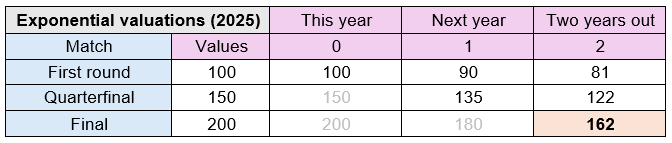
Discounting at a rate of 10% per year, you would opt to wait to see the championship match in two years. And next year, as the table below shows, your preference would remain unchanged.
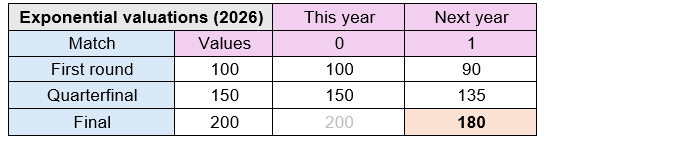
In 2026, you would prefer to continue to wait to see the championship match in 2027. This is all fine and well, except that people don't discount value at the same rate each year. People actually tend to discount value much more quickly in the first year as compared to later years (remember, we don't like to wait).
Case 2 – Hyperbolic (non-constant rate) discounting
Suppose that you discount the value of the matches at a rate of ~30% in the first year, followed by ~10% in the second year and beyond. Your valuations this year are shown below:
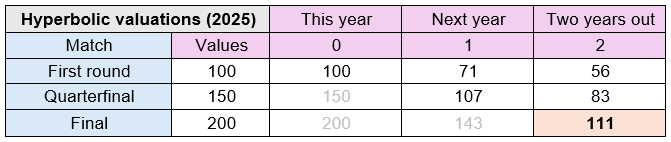
As before, you would prefer to wait until 2027 to see the championship match. Nothing new. However, something interesting happens in the second year. Given the new discount rates, your preference would actually switch to the quarterfinal match. Have a look:
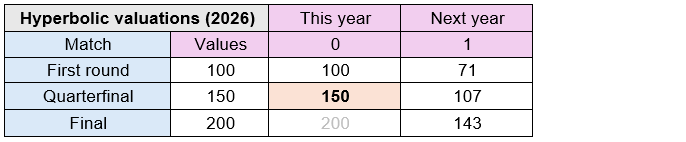
Many people exhibit the behavior in this second instance. The second year arrives, and rather than continue to wait, we decide to "cash in" and see the quarterfinal match instead. This is because of the shape of our discount function – We tend to discount value faster in the near future, followed by relatively shallow discounting of more distant prospects.
The graphs below summarize the tables above, showing a comparison of constant rate (left column) and non-constant rate (right column) valuations for this year (2025, top) and next year (2026, bottom). In the case of hyperbolic (non-constant rate) discounting, the highest valuation switches from the championship match (2025) to the quarterfinal match (2026).
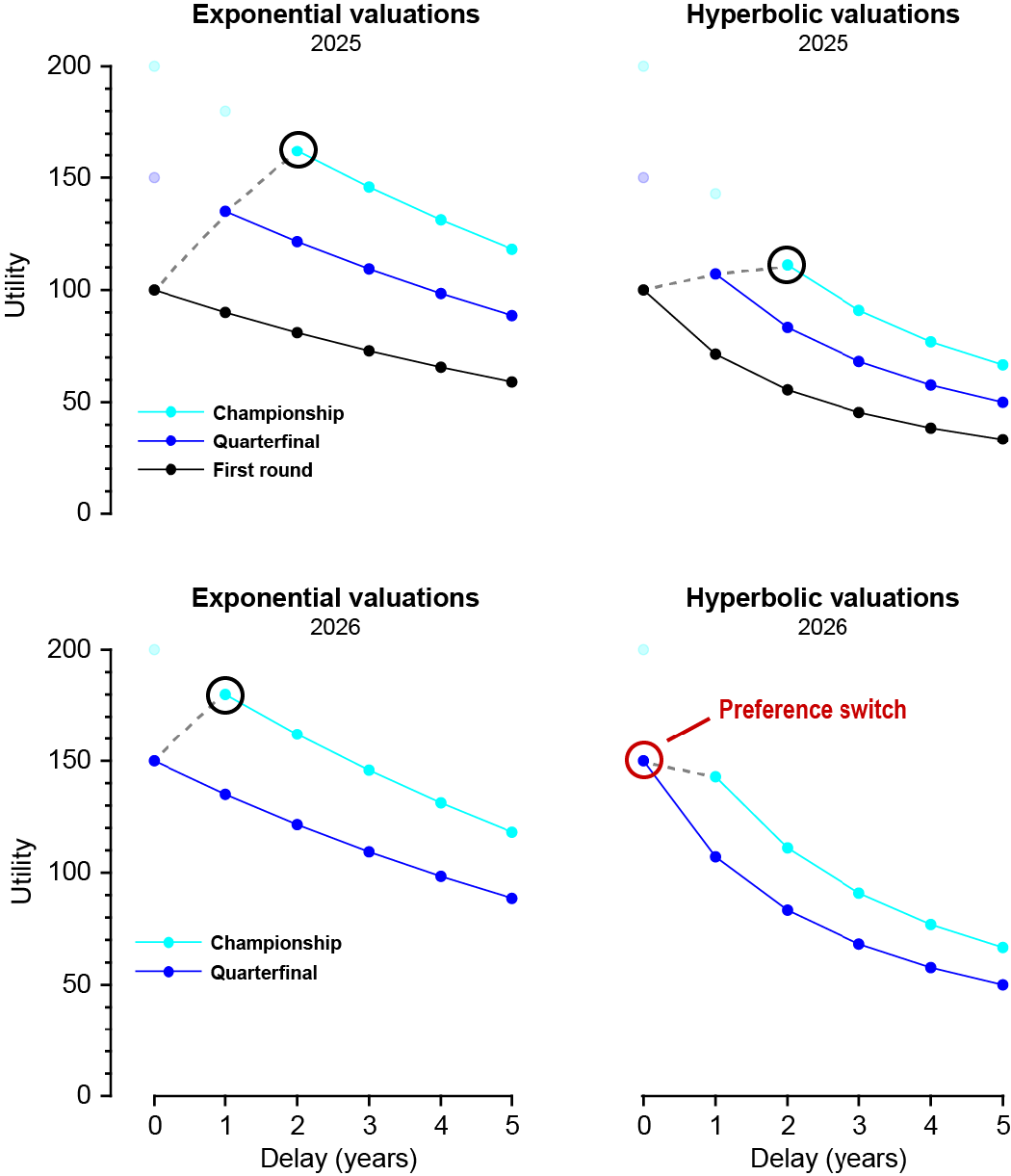
If people were rational in their decision-making, then they wouldn't switch their preference from one prospect to another simply because more time has passed. But humans are not entirely rational, and this is one well-documented example that showcases our irrationality. This is part of the reason I enjoy observing and measuring human decision-making, and what makes it so interesting!
References
Thaler, R. H. (2015). Misbehaving: The making of behavioral economics. WW Norton & Company.